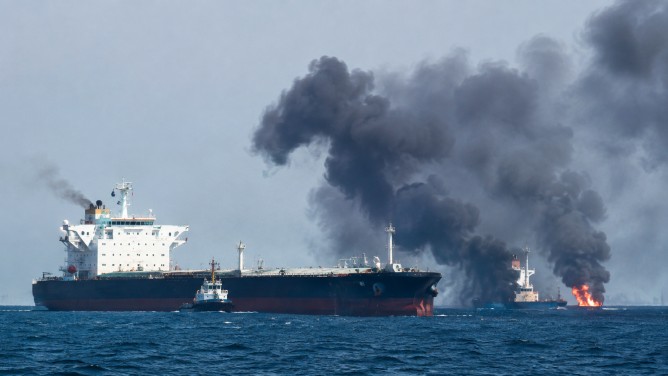
The Islamic Revolutionary Guard Corps (IRGC) of Iran announced that it had engaged two oil tankers which were in the process of navigating the Strait of Hormuz with U.S. military protection, asserting that these ships had deviated from its sanctioned maritime path. Following this confrontation, the IRGC noted that four additional tankers decided to retreat. The Strait of Hormuz, a crucial corridor for global energy transport, has encountered significant interruptions amid heightened hostilities between Iran and the United States. These rising tensions have not only curtailed maritime activities but have also propelled global crude oil prices to exceed $90 per barrel.
Amidst this regional unrest, Kuwait reported the interception of Iranian drones aimed at vital military and strategic sites, though the incident reportedly resulted in no casualties. Simultaneously, Israel launched a comprehensive assault near Beaufort Castle in Lebanon, claiming the operation targeted Hezbollah’s facilities. Lebanese authorities, however, accused Israel of violating the ceasefire agreement with this action.
In the United States, President Donald Trump gathered his cabinet at Camp David to deliberate on the ongoing conflict and its repercussions on the economy. The surge in fuel and consumer costs has intensified the strain on the U.S. government as the confrontation continues to unfold. Furthermore, recent opinion surveys suggest waning public approval for the war, adding to the administration’s challenges.
The enduring instability in the region has inadvertently bolstered the financial performance of leading energy firms, as the elevated oil prices continue to influence global markets. This economic impact is further compounded by the reduced maritime traffic in the Strait of Hormuz, underscoring the broader geopolitical implications of the conflict.