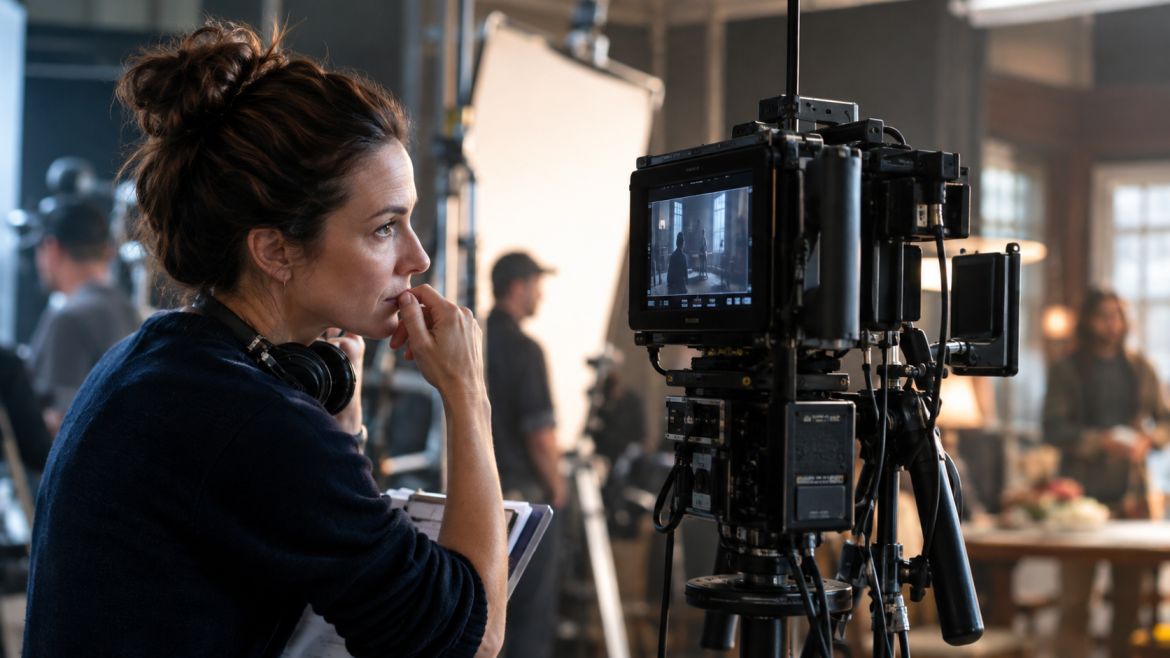
The struggle for female filmmakers to advance beyond their initial projects remains a significant challenge, as highlighted by Kristy Matheson, director of the London film festival. Matheson noted that despite efforts to improve gender parity, the film industry still sees limited progress in representation. Her observations coincided with the announcement of the London film festival’s complete lineup for its 2026 edition, scheduled from October 7 to 19. This year’s program features 251 titles, with women directing 109 of them, accounting for 43% of the total. However, only two of the 21 gala films are helmed by female directors.
This data underscores a broader conversation about gender inequality within the cinematic world. The Venice film festival has similarly faced scrutiny over its representation of female directors, an issue that jury president Maggie Gyllenhaal has attributed to systemic barriers, including restricted access to funding. Matheson emphasized that while there is a wealth of high-quality work from women early in their careers, representation diminishes as filmmakers attempt to produce subsequent projects. Female directors are well-represented in short films and debut features, but their presence declines notably in later works.
“The statistics are not where you would want them to be,” Matheson stated, pointing out that the festival could easily fill its Sutherland competition for first-time directors exclusively with films by women. The discrepancy becomes even more pronounced in the festival’s more prominent sections, sparking questions about the opportunities available for women to direct larger-budget projects and sustain careers over multiple films. Matheson acknowledged that this issue is not exclusive to this year’s festival, noting a lack of substantial improvement in recent years.
In addition to the films, the festival will present screen talks featuring notable figures such as Andrew Scott, Ava DuVernay, Cynthia Erivo, Jesse Eisenberg, John Malkovich, Sofia Coppola, Brad Bird, James Gray, Mahershala Ali, Naomi Ackie, and Danny Boyle. The festival will kick off with the European premiere of Simon Stone’s Elsinore, starring Andrew Scott and Olivia Colman, which narrates the story of actor Ian Charleson. Jesse Eisenberg’s comedy The Debut, featuring Julianne Moore and Paul Giamatti and set in the world of community theatre, will close the event with its UK premiere.
Matheson remarked that both Elsinore and The Debut explore the significance of creative communities, albeit in distinct tones. “To make theatre is to be with others. It’s an act of community,” she reflected. The films delve into themes of transformation and characters facing pivotal changes, while also examining the role creative communities play in individuals’ lives. Themes of work and labor are woven throughout the program, with Mike Leigh’s Tender Loving Care and Boots Riley’s I Love Boosters tackling issues of social care and collective action. Other films in the lineup explore concepts of community, care, and belonging, such as All of a Sudden, which is set in a nursing home and examines friendship and connection.