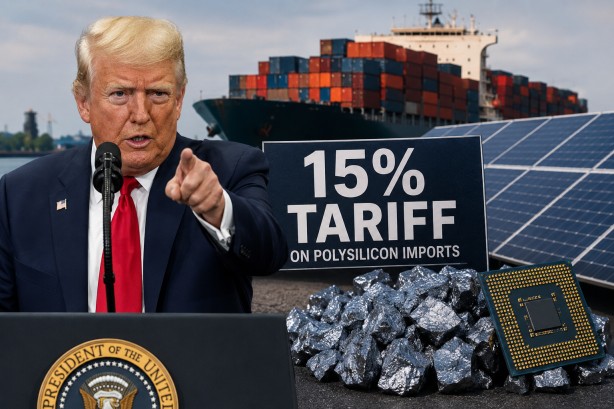
In a move designed to bolster domestic industry, US President Donald Trump has announced the imposition of a 15% tariff on imported goods made with polysilicon, a critical component in the production of semiconductors and solar panels. This tariff, set to be enforced starting December 4, is part of a broader strategy to reduce the United States’ reliance on Chinese imports and to enhance local production capabilities in high-tech and renewable energy sectors.
Polysilicon, an ultra-pure form of silicon, plays an essential role in the manufacturing of semiconductors, which are pivotal for powering artificial intelligence systems and data centers, as well as in the creation of solar cells and panels. Currently, China stands as the leading global producer of polysilicon, a fact that has prompted the US to take steps to protect and promote its own supply chain. The newly introduced measures also stipulate minimum import prices, including $21 per kilogram for polysilicon, $100 per kilogram for polysilicon ingots and wafers, $0.22 per watt for solar cells, and $0.38 per watt for solar modules and panels.
The US administration has articulated that these measures are crucial for ensuring the commercial sustainability of domestic polysilicon production and for securing supply chains that are vital to both economic stability and national security. Despite the intended benefits for US industry, China has voiced strong opposition to this policy, accusing the United States of leveraging national security as a pretext to unjustly constrain Chinese business operations. China warns that such protectionist measures could escalate tensions and potentially disrupt trade relations between the two economic powerhouses.
Currently, the US polysilicon production landscape is primarily supported by two major facilities: Hemlock Semiconductor in Michigan and Wacker Chemie’s plant in Tennessee. The newly implemented tariff policy is also designed to encourage investment in the domestic polysilicon sector by allowing the US government to provide incentives for companies willing to invest in local manufacturing capabilities.
This tariff comes against the backdrop of China’s robust export performance, particularly in areas such as electronics and products related to artificial intelligence, along with other sectors of high-value manufacturing. The US’s strategic move highlights the ongoing global competition in advanced technology and renewable energy, underscoring the economic and strategic imperatives facing both nations.